It represents a nutritional approach characterized by a drastic reduction in carbohydrates and an increase in protein consumption. With this diet our body uses the fatty acids present as a substrate for the production of ketone bodies used as an energy source. The metabolic condition that is created is called PHYSIOLOGICAL KETOSIS.
In summary, KETOSIS means FUEL CHANGE TO PROVIDE ENERGY.
STUDY
There was a study done on 8 experienced cyclists of at least 5 years.
Aim: Determine the effects of a long-term ketogenic diet on aerobic performance and exercise metabolism in off-road racing cyclists.
Method: The 8 cyclists with at least 5 years of experience who have a vo2max of at least 55ml/kg/min, have conducted a preparatory period to the racing season. The 8 cyclists are divided in 2 groups: one group associated on a mixed diet (50% carbogydrate, 30% fat and 20% proteins); the other group associated on a ketogenic diet (70% fat, 15% proteins and 15% carbohydrate). The 2 diets were later exchanged. The study was divided in two phases: – 3-day test phase, preceded by 4 weeks of diet. Between the two dietary intervals an interval of one week of recovery without food restrictions was incorporated.
Similar workloads in the 2 groups: high volume and moderate intensity.
Evaluation: For the evaluation was performed:
1) Progressive 2-day cycle ergometer test, heart rate, oxygen consumption and carbon dioxide exhaled, lactate threshold evaluation. 2) Test cyclorgometer with continuous effort at 3 days with variable intensity, BLOOD TESTS were carried out to determine: Insulin, cortisol, testosterone, total cholesterol, triglycerides, lipoproteins HDL and LDL, glucose at rest and β-hydroxybutyrate, body mass and body composition.
RESULTS
A) BODY MASS AND BODY COMPOSITION
The weight, the BMI and the fat mass of the subjects subjected to ketogenic are lower than those subjected to a mixed diet.
B) LIPID AND LIPOPROTEIN PROFILES
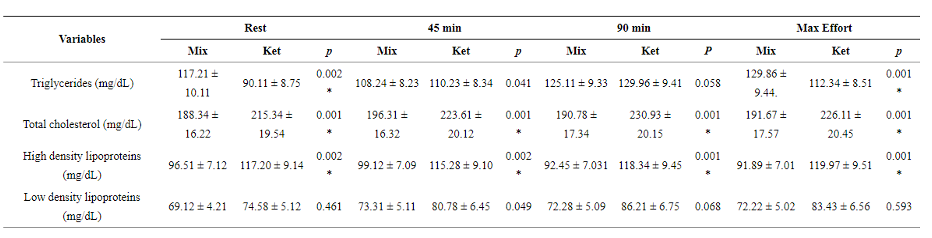
An improvement in the lipid profile of triglycerides (decreased) and HDL lipoproteins (increased) is observed.
Significant differences were recorded for total cholesterol and LDL lipoproteins.
C) HEART RATE, RESPIRATORY EXCHANGE AND VO2
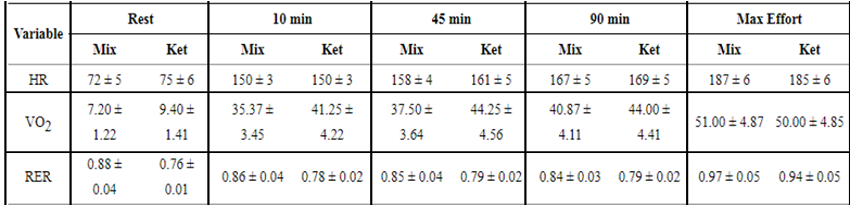
Lower [RER] is observed in the ketogenic diet, but higher HR and VO2.
D) BIOCHEMICAL VARIABLES
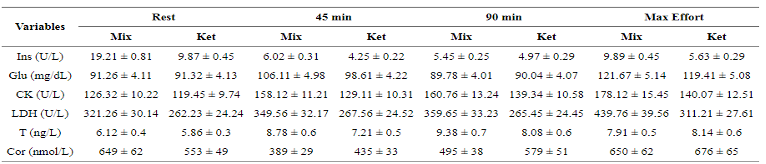
A statistically significant effect of exercise on insulin, glucose and cortisol is observed. Reduced [CK] and [LDH] both at rest and under stress.
E) FREE FATTY ACIDS AND LACTIC ACID CONCENTRATION
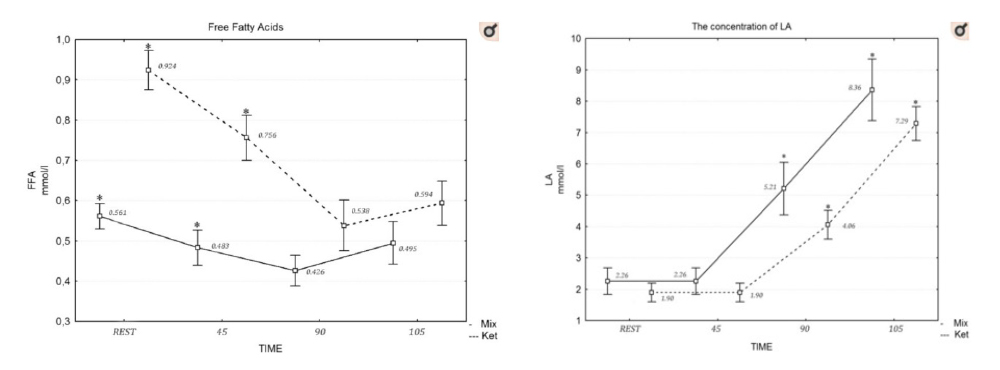
The ketogenic diet caused an increase in the FFA at rest and increased the FFA contribution to energy expenditure during moderate intensity exercise. During the last 15 minutes of exercise FFA metabolism is inhibited by glycolysis, evidenced by increases in LA.
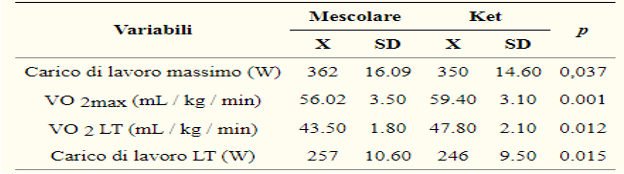
An improvement in the values of vo2max and LT VO2 is observed after the ketogenic diet.
The power delivered during the effort at maximum intensity is impaired by ketogenic.
DISCUSSIONS
The Ketogenic Diet has stimulated favorable changes in body mass and body composition, as well as in lipid and lipoprotein profiles. The reason is probably due to the predominance of polyunsaturated fatty acids.
Reduction of post-exercise muscle damage, observed by a reduction in plasma CK and LDH activity, attributed to the benefits of the fat-rich diet.
Significant improvement of vo2max and VO2 LT after the ketogenic diet, however the power delivered during work at maximum intensity was compromised by the ketogenic diet. This can be explained by lower muscle glycogen stores and reduced glycolytic enzyme activity
.
CONCLUSIONS
The ketogenic diet during a high-volume workout increases fat metabolism during exercise, reduces body mass and fat and decreases post-exercise muscle damage. The ketogenic diet, however, decreases the ability to perform high-intensity work, due to the decrease in glycogen stores. The ketogenic diet could be useful only during the preparatory season and not during the competitive activity. Further research is needed to understand the potential effects and uses of the ketogenic diet in athletes.